Expanding Japan’s Energy Storage Market
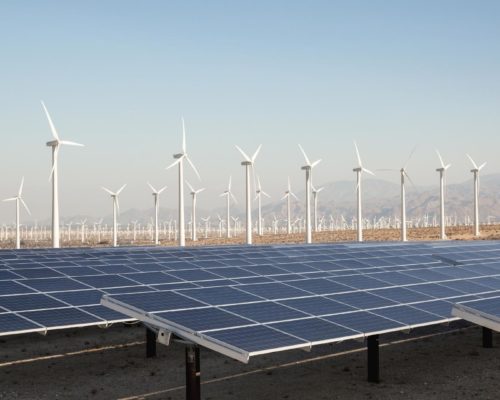
Aikawa Solar Power Plant, Aikawa Town, Kanagawa, Japan. Credit: Wikimedia
16 March 2026 – by Nithin Coca
Japan has made remarkable progress in adding solar and onshore wind to the grid and today is among the world leaders in grid solar generation. But there’s a growing challenge, as balancing electricity supply and demand in real time has stressed the grid due to the variability of renewable energy.
One potential solution is grid scale battery storage through the expansion of Japan’s energy storage market. Thus far, Japan is lagging behind countries like the United States, Germany and Denmark in building energy storage. According to a new report from the Renewable Energy Institute (REI) Japan, expanding stationary batteries and large-capacity onboard batteries in electric vehicles could drive innovation across the entire power system and enable the expansion of solar and wind without harming grid reliability.
“Globally, it is well demonstrated that stable supply is achievable even when variable renewables like solar and wind make up the majority of power generation. This is possible through demand-side flexibility […] grid reinforcement and battery storage. Japan does not need to build new fossil thermal plants to expand renewables,” said Yuri Okubo, a senior climate engagement strategist at REI.
Japan has a big opportunity. So far, grid-scale energy storage has lagged behind Japan’s remarkable expansion of solar and onshore wind. Expanding the Japanese energy storage market could unlock massive potential in clean energy and reduce the need to continue to import expensive oil and gas from abroad.
Energy Storage and Renewables
Japan faces a lot of challenges in its energy transition. The country has long been reliant on fossil fuels due to its near-total lack of oil, gas or coal reserves. Solar and wind are plentiful, but a challenging geography has made tapping into both sources slow.
One reason is bringing power from solar- or wind-rich regions to cities and balancing that with demand. In places like Europe and the US, interconnections allow clean energy to flow from regions that can produce it plentifully to regions with less potential. This means that if the sun isn’t shining in Spain but is in Germany, then the grid can still manage.
Japan, however, lacks connections to any other country’s grid due to its location as an island nation. That means it has to produce all of its power domestically, and, due to its size, that means it is more subject to fluctuations in solar and wind availability than other countries with larger-scale grids or connections to neighboring countries.
In recent years, renewable intermittency has become a bigger issue for grid management and at times has led to fluctuations in power availability. That is where grid-scale storage can come in, argues REI. Cheaper and more effective batteries and an advancement in energy storage technologies that allow for charging and discharging have made it possible to shift electricity supply and demand over time.
“What’s now at stake is a fundamental question of policy design: What kind of system is truly needed to put renewable energy at the center?” said Okubo.
Expanding Grid-scale Battery Energy Storage Systems
So far, Japan’s major utilities have focused on expanding baseload power and not grid-scale energy storage. That means coal and fossil gas thermal plants, or questionable decarbonisation technology such as carbon capture or ammonia co-firing, are the focus of investments, not grid-scale storage. That is problematic, according to Martin Norman, investor engagement lead at the Australasian Centre for Corporate Responsibility.
“Electric utility companies in Japan, many of which are highly leveraged, remain focused on centralised baseload despite operating in a grid increasingly reliant on renewable energy supply. Investors are eager for more prudent capital allocation,” said Norman.
To enable more wind and solar, Japan needs better institutional frameworks and market mechanisms to expand grid-scale storage systems. Utilities can both take the lead and push to better implement policies.
“Japan’s electricity utility companies must be considering grid-scale batteries in their decarbonisation and capital allocation decisions. If they aren’t, the question is, why not?” added Norman.
Moreover, expanding battery storage could allow for more wind and solar to enter the grid and would also reduce concerns about renewable intermittency, negating the need for peaker gas and coal plants.

Energy Storage and Japan’s Energy Security
Currently, Japan gets much of its electricity generation from imported fossil gas. Over the past few years, the prices of fossil gas have fluctuated greatly, and as a result, Japanese electricity consumers are paying some of the highest rates in the world. Solar and wind, alongside battery storage, could dramatically reduce costs while also lessening economic dependence on a country like Russia or Iran.
“An important window is now open for Japanese utilities on battery investment. The conditions for battery investment are favourable and with such a strong business case it is only a matter of time before there is broader commercial uptake,” said Norman.
There have been some positive steps in this direction, such as a 48 megawatt (MW) project led by KEPCO and a 240 MW installation at the Kita Toyotomi Substation in Hokkaido. Last year. USD 2.6 billion was committed by investors to battery storage. It’s a strong start, but much, much more needs to be done.
“Time is of the essence, making it crucial that investors engage with Japan’s electric utilities to ensure they are acting to guarantee a first-mover advantage,” said Norman.
by Nithin Coca
Nithin Coca covers climate, environment, and supply chains across Asia. He has been awarded fellowships from the Solutions Journalism Network, the Pulitzer Center, and the International Center for Journalists. His features have appeared in outlets like the Washington Post, Financial Times, Foreign Policy, The Diplomat, Foreign Affairs and more.
Read moreOur Publications