Thailand’s Energy Sector in 2026
08 March 2026 – by Viktor Tachev
Over the past decades, Thailand has transitioned from an energy sector dominated by coal and oil to one in which natural gas and LNG have become the primary sources of electricity generation. The shift started after the discovery and utilisation of natural gas in the Gulf of Thailand. Since a portion of it has been allocated to the petrochemical industry as feedstock, the power generation sector has struggled to meet Thailand’s rising energy demand. As a result, the country has been investing heavily in LNG import infrastructure. However, this has presented Thailand with various challenges, including undermining its net-zero journey, imposing high power costs on businesses and end users and undermining energy security.
The Beginning of Thailand’s Energy Sector Journey
Thailand’s journey in domestic energy production began with the discovery of crude oil in the Fang district, Chiang Mai, in 1918, sparking hope also for the presence of natural gas resources within the country’s territory.
In the following years, Thailand’s power sector relied on coal and oil for electricity generation until the discovery of natural gas in the Gulf of Thailand in 1973. The field, with estimated recoverable reserves of 1.5 trillion cubic feet in natural gas, marked a crucial turning point, marking the start of the so-called Bright Age — a new era of energy self-sufficiency for the country.

In 1978, the field was officially named “Erawan Field,” and Thailand signed the first natural gas purchase agreement. In 1980, PTT Public Company Limited (PTT) invested in the construction of a 425-km subsea pipeline to connect the Erawan field to Rayong Province. Production officially commenced in 1981, with the sourced natural gas used to generate electricity at the Bang Pakong Power Plant in Chachoengsao Province, Thailand’s first gas-fired power plant.
By the 1990s, Erawan, operated by Chevron Thailand Exploration and Production, had become the central pillar of Thailand’s gas production, with output exceeding 700 million cubic feet (19.8 million cubic metres) per day at its peak, empowering the country’s notable economic growth and industrialisation boom.
The natural gas discovered in the Gulf of Thailand was classified as “wet gas,” primarily consisting of methane, along with significant amounts of ethane, propane, butane and pentane. Methane is used as fuel in power plants, industrial facilities and natural gas vehicles (NGVs), while the remaining components can serve the needs of the petrochemical industry, such as for the production of plastic pellets, liquefied petroleum gas (LPG) for household cooking and vehicle fuel.
Instead of using the “wet gas” solely for electricity generation, PTT invested in building the first natural gas separation plant, which began operations in 1984, to diversify gas uses and generate greater economic value by using all of its components. However, the remaining natural gas available for electricity generation became insufficient, leading to additional gas and LNG imports from other sources, such as Myanmar. This, in turn, led to massive investments in infrastructure to support the future natural gas supply, including the expansion of pipelines connecting gas fields to power plants and the construction of LNG receiving terminals to accommodate shipments.
From the Gulf of Thailand’s Gas to LNG Imports
Factors such as the booming economy, rapid industrialisation and the increasing use of domestically sourced natural gas for the needs of the feedstock industry prompted Thailand to begin importing natural gas from Myanmar in 2000 via a pipeline to the Ban E-Tong receiving point in Thong Pha Phum District, Kanchanaburi Province. Back then, Thailand relied on natural gas for 62% of its electricity generation.

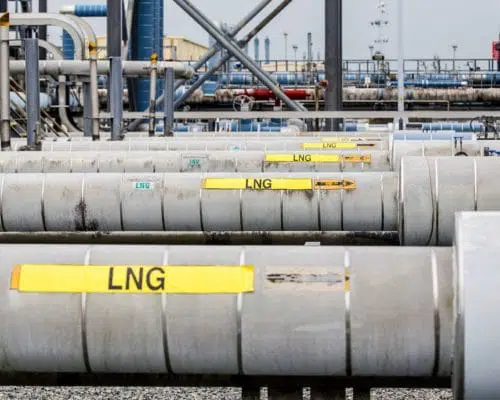
The country followed up by building its first LNG terminal in 2011. With a regasification capacity of 5 million tonnes per year, it marked the beginning of Thailand’s LNG imports. In 2018, its regasification capacity was expanded to 11 million tonnes per year, with the project costing THB 49.1 billion (USD 1.58 billion). At that time, LNG imports accounted for 2.18% of total natural gas imports, sourced from Qatar, Nigeria, Indonesia, Peru and Russia.
Next, Thailand opened a second LNG terminal with a regasification capacity of 7.5 million tonnes per year in 2022. The reason was the consistent decline in natural gas reserves in the Gulf of Thailand and the reduced deliveries from Myanmar, prompting increased reliance on LNG imports. The primary goals of the investment were to meet domestic energy demand and, in the long term, position Thailand as a regional LNG trading hub in ASEAN.
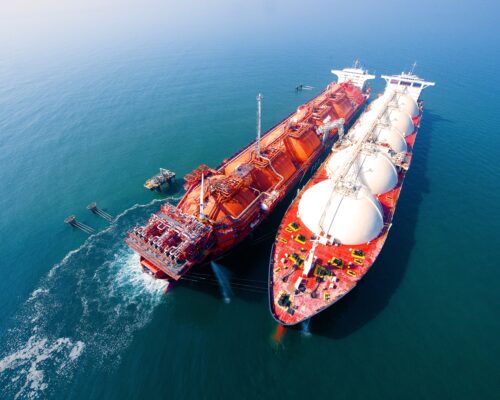
In 2024, the country was the top LNG importer in Southeast Asia. As of February 2024, LNG imports accounted for 29.07% of total imports, an increase of 1,233.49% over 13 years, with import sources broadened to 26 countries. However, Qatar has remained Thailand’s dominant LNG supplier, accounting for a cumulative 42.69% of all imports, followed by Malaysia (14.02%) and Australia (13.35%).
Furthermore, in October 2025, Thailand struck a deal with the Trump administration, agreeing to buy energy products, including LNG, crude oil and ethane, valued at approximately USD 5.4 billion per year from the US. Zero Carbon Analytics notes that, as per the agreement, Thailand would import an additional 1 million tonnes of US LNG in 2026, followed by another 1 million tonnes over the next five years. In May 2025, state-owned oil and gas company PTT said it was ready to help by importing more LNG from the US, including from the Alaska LNG project. A month later, PTT signed an agreement to import 2 million tonnes of LNG annually from the Alaska LNG project for 20 years.
Before launching its second LNG terminal, the Thai government approved a project for a third LNG terminal in 2019, with completion scheduled for 2029. Authorities described the project as a way to enhance Thailand’s energy security. However, experts argue that the LNG expansion is unnecessary, since the 19 million tonnes per year capacity of the first two LNG terminals is sufficient to meet future gas demand. Furthermore, there are concerns that the project’s construction and operating costs would directly affect public electricity rates, delay the country’s net-zero transition and exacerbate the environmental impacts associated with its development. According to locals, the two LNG terminals operating in Thailand’s Rayong province have caused severe air and water pollution, and Greenpeace Thailand advisor Tara Buakamsri warns that plans to build a third LNG terminal in the town of Map Ta Phut in Rayong will further worsen the problem.
Thailand’s Plans For a Third LNG Terminal Risk Further Increasing Electricity Prices and Undermining Energy Security
Thailand’s energy mix is heavily dominated by fossil fuels, particularly natural gas, which accounts for around half of all electricity generation. In total, Ember estimates that fossil fuels account for 85% of Thailand’s electricity generation, and its power sector emissions have nearly doubled since 2000 due to increasing reliance on gas.

As of 2024, Thailand’s reliance on domestic natural gas has declined to 59.84% from 79.4% in 2011, while LNG imports have risen sharply to 29.07% of total supply, up from 2.18%. As a result, the average pool gas price in 2024 has increased to THB 308.60 (USD 9.93) per million British thermal units (BTU), up from THB 221.13 (USD 7.13) in 2011, reflecting Thailand’s growing dependence on LNG and its direct impact on the country’s overall energy costs.
However, experts see the share of imported LNG in Thailand’s gas mix climbing further to 60% by the mid-2030s.

The country’s two existing LNG terminals mean it currently boasts the largest operational LNG import capacity in ASEAN, capable of meeting Thailand’s gas deliveries until 2037. Furthermore, since they remain underutilised, experts argue that there is no point in building a costly third terminal, estimated at over THB 60 billion (USD 1.93 billion).
According to Thailand’s Gas Plan 2024, the share of LNG used to meet its gas needs will increase from 31% in 2024 to around 40% by 2030. As per the plan, the average LNG supply under existing contracts and additional procurement between 2024 and 2037 won’t exceed 15 million tonnes per year. Even in a worst-case scenario, where potential gas sources fall short of expectations or gas imports from Myanmar are disrupted, the average LNG supply is still projected to remain below 20 million tonnes per year, meaning that the combined capacity of the first two LNG terminals alone (19 million tonnes per year) would be sufficient to meet Thailand’s natural gas requirements throughout the Gas Plan period.
Concerns are also rising that the project will not only bind the country to continued dependence on gas imports but also transfer the high construction and operating costs to consumers through higher electricity bills. For example, over the course of 2022, the Institute for Energy Economics and Financial Analysis (IEEFA) estimates that growing LNG imports contributed to a doubling of domestic gas prices and record electricity prices.

According to Dr. Kurujit Nakornthap, director of the Petroleum and Energy Institute of Thailand, there is a dramatic difference between the cost of importing LNG, which in 2022 reached USD 38.66 per million BTU, and the price of gas in the Gulf of Thailand, at USD 5.51 per million BTU. On an annual basis, this amounted to a difference of up to USD 19,152 million, clearly reflecting the burden of energy costs on the public.
Renewable Energy Can Help Thailand Get Back to the Security of Domestic Energy Sources
As the Thai economy continues to grow and electricity demand, driven by industry, urbanisation and the expansion of digital infrastructure, increases further, the need for cleaner, cheaper and more reliable energy sources, such as renewables, will increase. In fact, the IEA notes that Thailand is already among the Asian countries that have achieved the largest savings on fossil fuel imports through the adoption of renewables.
According to BloombergNEF’s “Thailand: Turning Point for a Net-Zero Power Grid” report, utility-scale solar power has already become the lowest-cost source of large-scale electricity generation in the country, with the levelised cost of electricity (LCOE) for new solar projects ranging between USD 33 and USD 75 per MWh, significantly lower than the cost of building new gas-fired power plants (USD 79-86 per MWh). As a result, BNEF notes that scaling up renewables remains the most economically viable pathway for Thailand to meet its decarbonisation and energy transition goals, while boosting domestic energy security and affordability.
The country has vast renewable energy potential, particularly solar, estimated at around 300 GW, as well as stable market fundamentals, including solid experience with deploying residential solar systems.
All this, paired with concerns about underutilisation, stranded asset risk, high investment costs and the potential for these costs to be passed on to consumers, erodes the economic viability of the third LNG terminal. Furthermore, since such projects have operational lifespans of 25-30 years, they will bind the country to continued reliance on natural gas, further distancing it from its goal of reaching net zero by 2050.
Furthermore, pursuing the development of its third LNG terminal is counterproductive to Thailand’s mission to return to the golden days of affordable, secure and domestically sourced energy. Scaling up renewable energy, instead, can help the country reduce import dependence, stabilise electricity prices, strengthen long-term energy security and ultimately enter its new “Bright Age”.
by Viktor Tachev
Viktor has years of experience in financial markets and energy finance, working as a marketing consultant and content creator for leading institutions, NGOs, and tech startups. He is a regular contributor to knowledge hubs and magazines, tackling the latest trends in sustainability and green energy.
Read moreOur Publications