Bridging the Gender Gap: The Benefits of Including More Women in Asia’s Energy Sector
02 March 2026 – by Viktor Tachev
The IEA considers energy to be one of the least gender-diverse sectors of the global economy. Researchers identify persistent gender gas, discrimination and the decades-old stigma that women should be responsible for unrewarded and unpaid household and caregiving duties among the main reasons for the limited professional and educational opportunities. Despite recent progress, Asia remains among the regions where this problem is the most pronounced.
However, the tools to address it are clear, from a shift in mindset and policy changes to additional investments and targeted initiatives from international partners to empower women’s participation in specialised education programs and the workforce. If governments succeed in creating a more equitable environment for women, they would unlock massive economic and societal gains, including capitalising on the untapped talent potential in the energy sector, accelerating the energy transition, boosting GDP growth and improving the livelihoods of women and their families, particularly in low-income regions.
The Gender Gap: A Global Problem With Particularly Stark Implications Across Asia and Its Energy Sector
The 2025 Global Gender Gap Report, published by the World Economic Forum, is an annual benchmark for the current state and evolution of gender parity across different indicators. It ranks East Asia and the Pacific fifth out of the eight regions subject to analysis. The Philippines ranks 20th, followed by Thailand (66), Vietnam (74), and Indonesia (97). South Korea ranks 101st, while China is at 103rd position, and Japan is 118th.
In another study, the UN’s ESCAP concludes that countries like the Philippines (26.08%), Malaysia (26.08%), Indonesia (28.36%) and Myanmar (29.88%) face the widest gender gaps in the region. Furthermore, a significant part of the employed women work in low-skilled, low-paid and informal jobs, with limited social security and employment benefits.
The World Bank finds that, in South Asia, the gap between men and women in the workforce is still among the widest in the world, with only 32% of women of working age participating in the labour force. The problem is even more glaring in the energy sector, where women constitute just 1-25% of the workforce in energy utilities across the region.
According to S&P Global Market Intelligence, while women make up 13.6% of C-suite roles and 18.6% of board member positions in publicly traded energy companies, in the Asia-Pacific region, the shares are 18.6% and 15.5%, respectively.
Experts involved in the ASEAN Climate Change and Energy Project (ACCEPT) note that, despite regional efforts to promote equality, women make up only 8% of the energy workforce in ASEAN. This disparity is also evident on the government level, where all ministries and departments related to energy in ASEAN member states are currently led by men. In fact, some countries, like Indonesia, for example, have never had a female energy minister.
These regional statistics are well below the global average. According to the IEA, fewer than one in five leadership roles in the energy sector are held by women, and their wages remain 15% lower than those of men. Furthermore, just 11% of start-up founders in the energy sector are women, compared with nearly 20% in other industries.

Female representation in the clean energy sector is higher, at 32%, although still far from parity.
Longstanding Systemic Inequalities, Cultural and Gender Norms to Blame
Experts from ACCEPT consider the gender gap in Asia’s energy sector to be the result of intersecting barriers that have deepened over the years.
For example, some reasons for the region’s gender imbalance in the energy sector include labour participation, access to education and leadership opportunities. The intersection of these factors has resulted in a unique form of disadvantage that governments have been unable to fully address over the years.
Gender Bias and Discrimination
High-paying and formal jobs such as those within the engineering and science fields, including energy sector occupations, have long been considered masculine, resulting in an internalised gender bias that has prevented women from applying. Such issues have been further fueled by researchers’ findings that women in male-dominated workplaces have historically experienced high levels of discrimination.
The patriarchal culture present in many countries in the region also continues to dictate women’s career trajectories. According to experts, this reinforces the decades-old stigma that women should focus on household and caregiving duties, ultimately ousting them from various economic opportunities, high-paying jobs and political decision-making processes, including in sectors like energy, that would significantly impact their livelihoods.
This problem is also present within the education system. In a dedicated study titled “Gender stereotypes and education: A comparative content analysis of Malaysian, Indonesian, Pakistani and Bangladeshi school textbooks,” researchers found that government-issued school textbooks fuel the gender bias by illustrating women as housewives and men in prestigious jobs.
Energy industry experts argue that companies also consider female employees to be more expensive to employ due to the need to pay for parental leave. ESCAP notes that the scarcity of female role models and mentors in leadership positions compounds these trends, ultimately limiting young women’s ability to envision themselves in these careers.
Education Gap and Limited Leadership Opportunities
Women in the region face barriers to accessing qualified education and skill development programs, which further prevent them from entering high-paying sectors and taking on leadership roles in industries such as energy.
Statistics reveal that, on average, only 19.3% of women across ASEAN graduate with a STEM degree, the main requirement for taking a formal job in the energy sector.
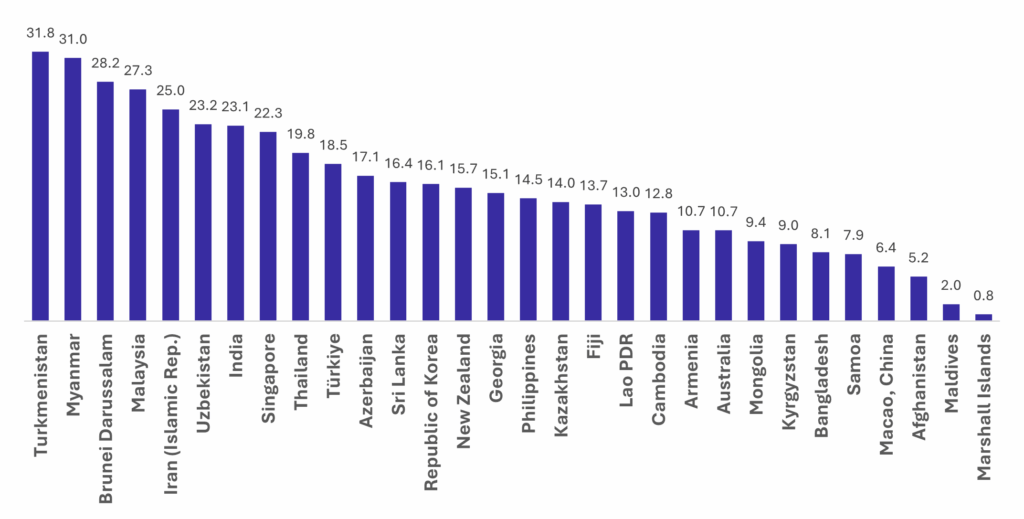
Statistics from the UN reveal that women hold 41% of management positions and 26% of middle- and senior-level positions across ASEAN. Within the government sector, women hold 22% of positions. However, there is a big caveat: women in high-level decision-making and ministerial positions are mainly chairs of gender-related committees, rather than those in other areas, like energy or foreign affairs.
Estimates indicate that globally, it will take 162 years for women to reach gender parity, especially in politics.
According to the 2025 Global Gender Gap Report, East Asia and the Pacific ranks sixth in Political Empowerment, with a score of just 15.3% for political parity, among the lowest in the study. Countries like Japan, Malaysia and Cambodia are performing poorly, with scores below 10%, while nine of the 19 regional economies have never had a female head of state.
The ASEAN Gender Outlook 2024 finds that women in Southeast Asia remain underrepresented in key environmental ministries. Furthermore, the Social Institutions and Gender Index score of 39 indicates medium and close to high discrimination against women and girls within Southeast Asia’s social institutions, way above the averages for the world (29) and for OECD countries (15). The case is no different in Asia-Pacific ESCAP member states, where no ministry of energy was headed by a woman as of 2024.
Strategies and Solutions For Bridging the Gender Gap in Asia’s Energy Sector
After reviewing the integration of women, and more broadly, gender issues in national-level energy policies across the Asia-Pacific region, researchers from the University of Sydney found that only 16 of the 385 policies included gender. Notably, 70% of them referred to gender in relation to energy at the household level. The researchers argue that energy policies reflect a government’s priorities, and the absence of gender considerations underscores the urgent need for the energy sector to evolve toward greater gender inclusivity to close existing gaps. Integrating gender into energy policies will ensure equitable energy planning, reduce inequities, promote women’s empowerment and provide opportunities for engagement in the energy sector, they note.
Experts from ACCEPT argue that addressing gender disparities in the region’s energy sector requires an intersectional approach that recognises how different social factors, including gender, class, education and cultural norms, interact to create unique forms of disadvantage. They also advocate adopting a more quantitative strategy, including setting periodic targets for women’s participation in energy programs, projects or at an institutional level, to bridge the gender gap. The experts argue that developing such comprehensive and inclusive regulations should also involve international collaboration, enabling the incorporation of broader insights that align with ASEAN’s objectives. Collaborating with international women’s organisations and leveraging the expertise of existing gender departments within the region are other invaluable measures for advancing a vision that aligns with both regional and global aspirations for gender equality in the energy sector.
Advancing the clean energy transition across the region is another strategy that will aid in bridging the gender gap in the energy sector. According to a joint report by Schneider Electric and the Alliance for Rural Electrification (ARE), while males dominate the traditional energy sector, with a female participation of just 16%, women make up an estimated 32% of the renewable energy sector. Considering that green jobs are on course to reach 30 million by 2030, Southeast Asia has a unique opportunity to advance inclusive development.
However, according to the IEEFA, capitalising on this opportunity requires targeted policies that focus on creating awareness, training and skill development, access to cheap finance, government schemes and subsidies. They must also address broader systemic gender issues such as property and equal access laws, land rights and political participation.
Bridging the Gender Gap: Lessons and Success Stories From Asia
In the energy sector, ASEAN has begun integrating gender considerations into long-term planning through mechanisms like the ASEAN Plan of Action for Energy Cooperation (APAEC) 2026-2030. While this marks a promising step forward, efforts should be supplemented by all stakeholders, including private sector initiatives.
A case in point is the South Asia Women in Power Sector Professional Network (WePOWER), a coalition of over 50 energy sector utilities and stakeholders promoting women’s participation in the region’s energy sector.
International partners and organisations also have a prominent role to play through targeted initiatives and training programs. For example, UNICEF is actively working to prepare girls for green jobs through STEM education opportunities and leadership training programs such as UPSHIFT, STEM4Girls and UniSat+, which are already bearing fruit for communities across Kazakhstan, Kyrgyzstan, Uzbekistan and Tajikistan.
Another successful example is UNDP’s targeted training on clean energy solutions, digital literacy and financial inclusion for 201 women from three remote villages in Indonesia’s Southwest Sumba, East Nusa Tenggara, one of the regions with the lowest human development index. As a result, women established three independent businesses utilising clean energy, adding value to their communities’ agricultural production and increasing their income and the economic stability of their families.
At a national level, countries like Cambodia, Indonesia, Myanmar, the Philippines and Vietnam, alongside international partners, have made progress in getting women more involved in the energy sector through various initiatives, such as the ASEAN Climate Change and Energy Project (ACCEPT) and the ASEAN RE-Gender Roadmap, for example. The latter identifies five key stakeholders critical to advancing gender equality in the energy sector, including policymakers, renewable energy companies, local communities and organisations, universities and regional and international institutions.
One of the region’s most remarkable success stories in promoting gender balance in the governmental sector comes from the Philippines, which has introduced the DOE Gender and Development dedicated group within the Department of Energy (DOE), as well as a specially designed gender toolkit, to acknowledge women as competent partners in policy and decision-making and systematically address gender-sensitive issues in traditionally male-dominated sectors.
Another shining example is the decision of Sri Lanka’s Ministry of Power and Renewable Energy to launch the Women’s Energy Leadership Initiative to provide leadership training and enable women’s participation in policy discussions.
Under the Cambodia Rural Electrification Fund, a collaboration between the government and external partners, women in remote areas are gaining access to affordable energy solutions, ultimately reducing the time they spend collecting firewood.
Huge Economic and Societal Gains Await if Governments Address the Gender Gap
According to the World Bank, the failure to ensure gender parity across many economic sectors, including energy, results in unrealised lifetime productivity and earnings losses of between USD 15 and USD 30 trillion. At the same time, closing the gender gap in employment across sectors could drive an average 20% increase in global GDP per capita.
On the corporate front, evidence shows that companies with more gender-balanced boards achieve higher returns and 30% lower earnings risk.
Furthermore, according to researchers, prioritising gender integration in energy policies isn’t only crucial for social equity, justice, women’s empowerment and their involvement in the energy sector, but also for stimulating economic growth by empowering women as energy producers and consumers.
Gender-sensitive approaches are found to reduce household poverty and improve the overall well-being of the community, as women tend to reinvest up to 90% of their income in community livelihoods and essential services, compared to 35% for men. In some instances, this has resulted in a 14% increase in local communities’ income.
CARE estimates that gender parity worldwide could increase global GDP by over 20% and unlock USD 172 trillion by bridging income gaps. This is critical for regions with fast-growing economies, like Southeast Asia, where income and gender disparities continue to hold back inclusive development.
ASEAN Has Made the First Step, Now It’s Time to Follow Through
The recognition of women’s contributions to the development of the ASEAN region began formally in 1988 with the signing of the Declaration on the Advancement of Women in ASEAN. This step was further reiterated in the Declaration on the Gender-Responsive Implementation of the ASEAN Community Vision 2025 and the Sustainable Development Goals, which emphasises that gender equality is central to the 2030 Agenda.
However, the region is still far from where it needs to be. The first and most crucial step in closing the gender gap is acknowledging that it hasn’t formed by chance. Instead, it is a natural extension of obsolete social structures that limit women’s development and participation in social and work life. Next is introducing the necessary policy reforms and incentives to stimulate and ease women’s engagement across various economic sectors, as well as to address the still prevalent gender bias in the public and private sectors and in educational institutions.
The escalating climate crisis and the urgent need to accelerate the clean energy transition have taken us to a point where it is now critical for all stakeholders — from educational institutions, investors and international organisations to energy sector companies and governments — to introduce inclusive solutions. This is important, as equipping and empowering women means doubling the talent pool and improving the lives of billions worldwide.
The climate crisis itself is indifferent to the gender gap, but if humanity hopes to stand a chance of addressing it, it cannot be.
by Viktor Tachev
Viktor has years of experience in financial markets and energy finance, working as a marketing consultant and content creator for leading institutions, NGOs, and tech startups. He is a regular contributor to knowledge hubs and magazines, tackling the latest trends in sustainability and green energy.
Read moreOur Publications