At ASEAN Energy Forum, Gas Industry and Regional Planners Draw Different Lessons From Hormuz
Flags at the ASEAN Energy Business Forum in Manila. By Wendy Lo.
08 October 2026 – by Wendy Lo
Gas demand in Asian countries is forecast to rise strongly in the coming decades, according to the latest ASEAN Energy Outlook report released Thursday, increasing the risks of a long-term dependence on often volatile fossil fuel imports.
While regional planners highlighted the need for renewable sources to maintain energy security, especially in light of the disruptions to gas imports through the Strait of Hormuz, industry executives seemed to draw different lessons from the bout of volatility, betting that gas would receive significant investment despite the ongoing market uncertainties.
“There’s a general wave to transition to renewable energy, but I’ve always been personally an advocate of a balanced portfolio, which saves you in the ups and downs of geopolitical events,” said Jose Victor Emmanuel “Jocot” de Dios, President and CEO of Philippine gas power producer Prime CoreGen, at the 26th ASEAN Energy Business Forum in Manila on Oct. 8.
De Dios argued that conventional fuels should remain part of Southeast Asia’s energy mix to protect against geopolitical shocks. Yet a regional outlook released at the same forum suggests that growing gas dependence could leave the region increasingly exposed to the very disruptions it seeks to withstand.
The 9th ASEAN Energy Outlook, launched by the ASEAN Centre for Energy (ACE), projects that the region’s gas supply will increase sevenfold between 2025 and 2060 under a baseline scenario that extends current trends. Even under member states’ stated targets, gas supply grows more than fivefold, while ACE’s more ambitious coordinated transition pathway still sees it nearly quadruple.
Under member states’ stated targets, coal’s share of centralized electricity generation falls to about 1% by 2060, but gas accounts for around 58%. The authors of the ASEAN Energy Outlook warned that this creates a “potential risk of long-term gas lock-in.”
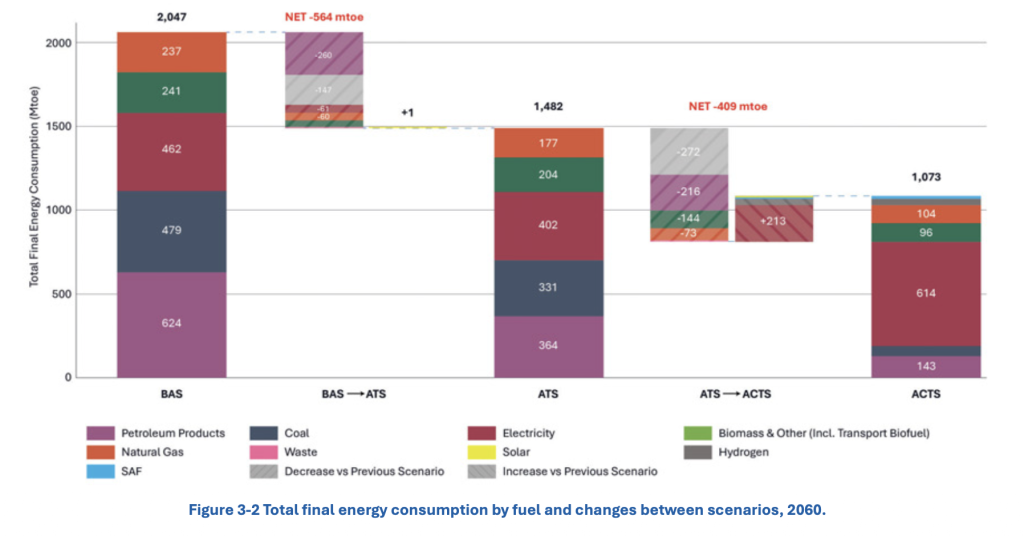
ASEAN’s direct gas use is projected to reach 237 Mtoe by 2060 under current trends (BAS in the chart), compared with 177 Mtoe under national targets (ATS) and 104 Mtoe under a coordinated transition (ACTS). Source: ASEAN Centre for Energy.
ASEAN’s Growing Exposure to Imported Gas
ASEAN’s projected gas expansion coincides with a weakening regional supply position. According to the Energy Outlook, the region’s gas trade surplus has roughly halved since 2005, bringing the region closer to becoming a net gas importer.
De Dios, whose company operates about 2 GW of gas-fired power plants in the Philippines, expects ASEAN to become a net gas importer as early as 2027. He argued that declining upstream reserves could leave new gas pipelines stranded, making LNG terminals and floating storage and regasification units a more flexible option for securing imports.
However, greater reliance on LNG also exposes ASEAN to international price volatility and supply disruptions. The International Energy Agency’s ASEAN Energy Security Review, also released this week, found that around 45% of the region’s LNG purchases in 2025 were made through spot and short-term contracts, with the Philippines and Vietnam relying predominantly on the spot market.
Despite the disruption, ASEAN’s LNG imports rose about 20% year on year in the first eight months of 2026, reflecting limited opportunities to switch fuels. The IEA projects the Philippines’ gas import dependency to reach around 80% by 2030 and warns that new LNG infrastructure must account for the risk of overbuilding.
Renewables Offer a Path to Lower Gas Dependence
The ASEAN Energy Outlook suggests that the region could limit its future gas dependence through faster renewable energy deployment, although the pace required is far beyond historical levels.
Renewables supplied 14.1% of ASEAN’s primary energy in 2024, well below the region’s 23% target for 2025. Reaching the 2030 goal of 45% renewable installed capacity would require around 31 GW of new renewable capacity annually, compared with a historical average of just 6.5 GW.
Under the coordinated transition scenario, renewables provide about 48% of electricity generation by 2060, while gas accounts for 37%. The shift would require more than 300 GW of energy storage, predominantly batteries. ACE estimates that the coordinated pathway requires USD 14.2 trillion in cumulative energy investment through 2060, compared with USD 7.8 trillion under the baseline.
Despite the different emphasis placed on gas, ACE and industry executives agree that ASEAN faces a major challenge in turning its energy plans into operational projects.
ACE identifies implementation as a central obstacle to meeting the region’s renewable energy targets. De Dios likewise described execution as the weakest link in regional energy planning, urging governments to make difficult decisions and follow through quickly to deliver better outcomes for consumers.
Our Publications