Six Months Into Energy Emergency, Philippines’ Rooftop Solar Surges but Barely Taps Its Potential
24 September 2026 – by Wendy Lo
Six months after the Philippines declared a State of Energy Emergency, rooftop solar installations are accelerating, electricity prices remain high and the government is moving to cut permitting barriers. But for most households and small businesses, the main obstacle is not paperwork – it’s the upfront cost of installation, a barrier current policies have yet to address at scale.
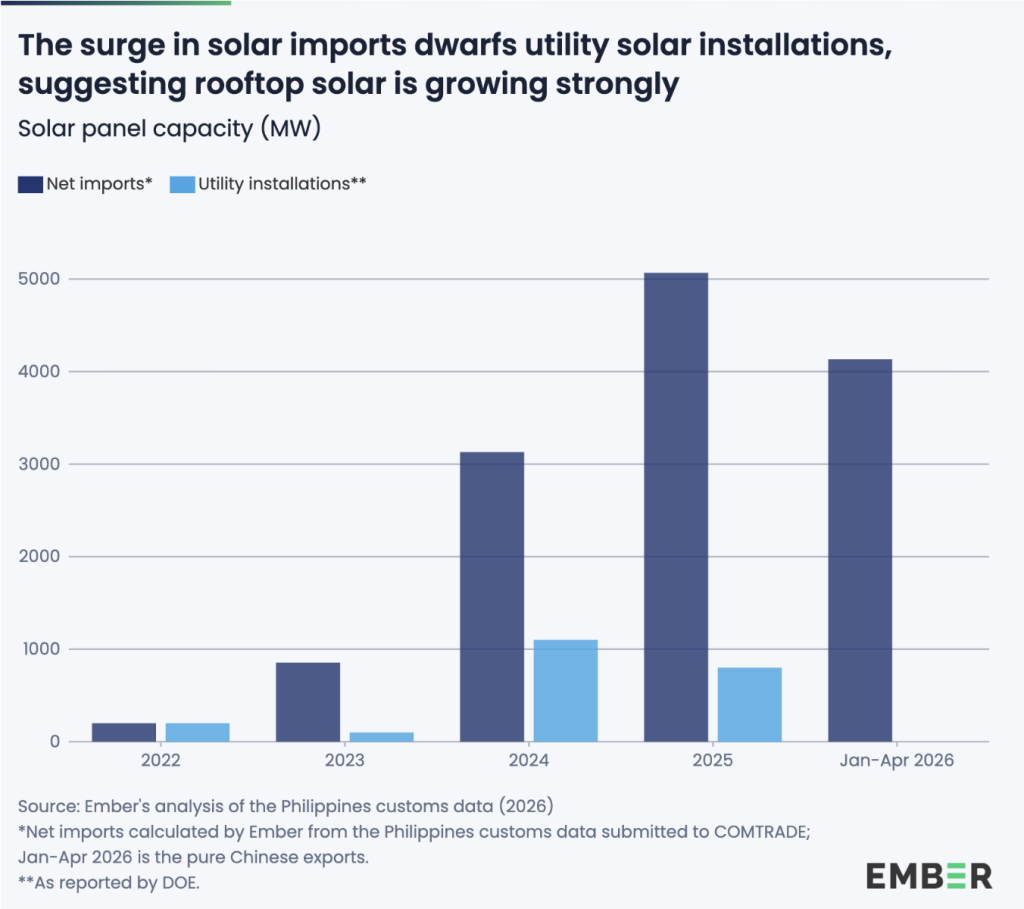
Rooftop solar capacity in the Philippines has nearly doubled over the past year to around 1,300 MW, according to Ember. Solar panel imports suggest growth could accelerate further. The Philippines imported 5,068 MW worth of solar panels in 2025, more than five times the amount of utility-scale solar installed that year. In March and April 2026 alone, China exported more than 3,000 MW of panels to the Philippines, making it China’s second-largest solar panel export market so far this year.
Yet installed rooftop capacity remains around 1% of the country’s theoretical potential. The Institute for Climate and Sustainable Cities estimates that rooftops across the Philippines could support 106,000 MW of solar.
High Electricity Prices Shorten Solar Payback Periods
Payback periods for rooftop solar panels – the time it takes for electricity bill savings to make up for installation costs – have shortened sharply across all customer segments. Between May 2025 and May 2026, the payback period fell from 4.0 to 3.1 years for residential solar, from 3.0 to 2.3 years for commercial users and from 3.9 to 3.1 years for the industrial sector, according to Ember.
The biggest driver is rising electricity prices. A Department of Energy comparison published in March ranked the Philippines as having Southeast Asia’s highest residential electricity prices, the second-highest commercial prices and the third-highest industrial prices.
Alnie Demoral, energy analyst at Ember, told Energy Tracker Asia that falling equipment costs and greater competition have also improved the economics, but high electricity prices remain the dominant factor.
“It is difficult to see electricity prices falling sustainably given the continued exposure of fossil-based generation to fuel costs and supply risks,” Demoral said. “Solar PV costs, on the other hand, can continue to decline as deployment scales and economies of scale kick in.”
Permitting Barriers Ease, but Financing Remains Limited
The government has moved to remove several regulatory barriers to rooftop solar. Net metering approval has been streamlined to 10 days, while electrical permits can now be issued within three working days. New regulations effective June 2026 allow larger commercial customers to procure solar power directly from developers through power purchase agreements.
The proposed Sariling Kuryente Act has also gained political momentum following the president’s endorsement. The bill would allow households and businesses to install behind-the-meter solar and storage for their own use without being subject to requirements designed for commercial power producers.
One of the few financing mechanisms available is the GSIS Ginhawa Solar Energy Loan, which offers loans at 5% interest repayable over five years. But eligibility is limited to government employees and qualified pensioners. An estimated 40 million private sector workers have no equivalent programme.
Demoral said expanding financing and further regulatory reform should not be treated as competing priorities because they address different barriers.
One option is a regulatory framework for plug-and-play solar, which would allow systems of up to 800 watts to connect directly to a standard wall socket without going through net metering registration, a practice not currently permitted in the Philippines. Ember estimates these systems can cost almost half as much per watt as conventional rooftop installations, cutting payback periods to less than two years.
Rooftop Solar Growth Could Reduce LNG Dependence
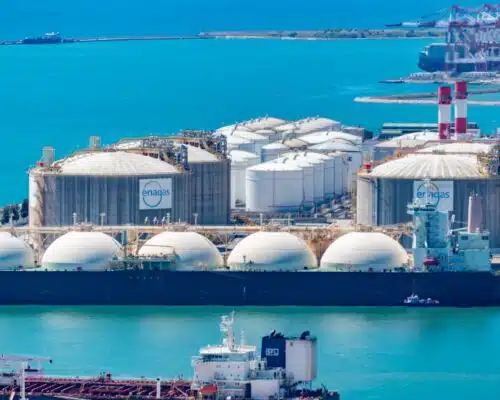
Faster rooftop solar deployment could have consequences beyond household electricity bills. Meralco, which serves more than half of electricity demand in the Philippines, sources around 60% of its supply from natural gas, almost all of it US dollar-denominated LNG, according to Ember. That leaves consumers exposed to movements in global gas prices and exchange rates.
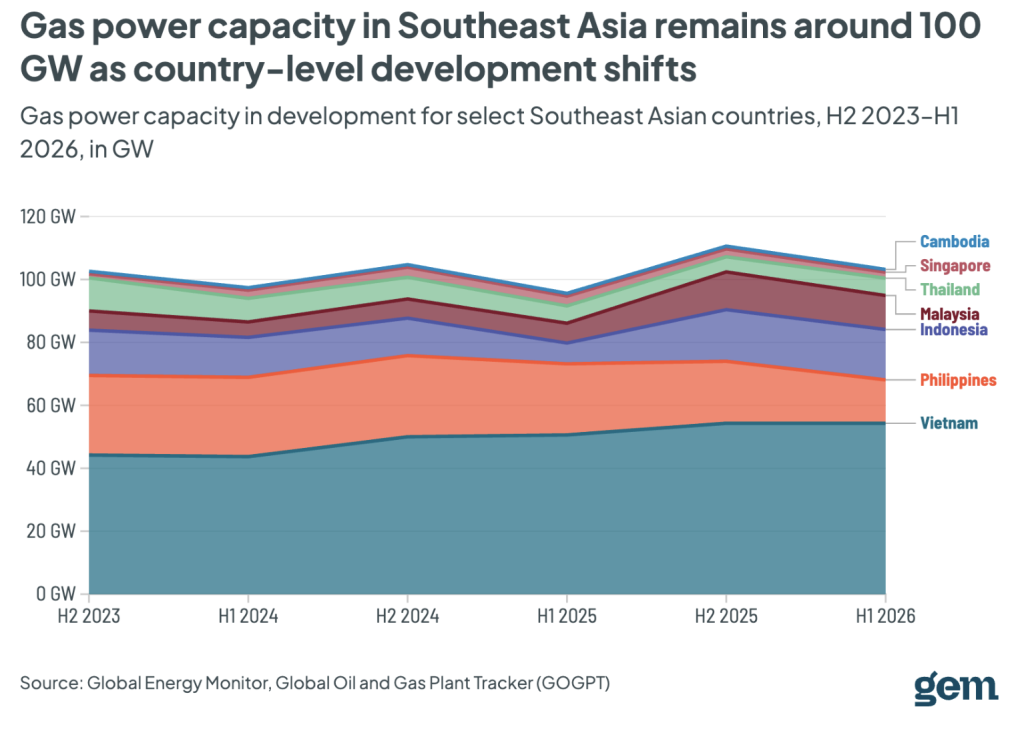
The Philippines’ exposure is part of a wider regional expansion in gas infrastructure. A September 2026 report from Global Energy Monitor found that more than 100 GW of gas-fired power capacity remains in development across Southeast Asia, while LNG import capacity under development has increased from around 47 million tonnes per annum in 2024 to about 70 mtpa today.
That expansion comes as conflict in the Middle East has disrupted LNG supplies through the Strait of Hormuz and pushed up prices across the region.
“Import capacity does not guarantee secure LNG supply, and access to LNG does not guarantee affordability,” said Warda Ajaz, Project Manager of the Asia Gas Tracker at Global Energy Monitor.
Ember estimates that deploying 3,500 MW of rooftop solar with 4,500 MWh of battery storage could cut import dependence materially. At current prices, generating electricity from solar over 20 years would require around 20 times fewer imports than generating the same amount from gas.
Demoral said that if installations spread across a large share of households and commercial users, gas-fired plants could increasingly shift from supplying daytime electricity to providing backup capacity, directly reducing LNG consumption.
by Wendy Lo
Wendy Lo is a journalist covering renewable energy and industrial decarbonization across the Asia-Pacific. Her reporting examines the policies and market dynamics shaping the region’s energy transition.
Read moreOur Publications